

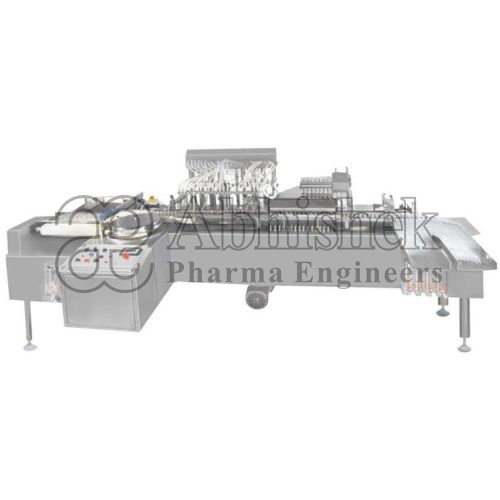
In pharmaceutical manufacturing, how a container is positioned during filling is as crucial as the filling process itself. By maintaining a vertical position, this ampoule filling and sealing machine uses gravity to ensure the liquid quickly settles at the bottom, away from the neck of the glass. This is essential for achieving a flawless seal, preventing leakage, and maintaining the quality of sensitive injectable drugs.
As a trusted ampoule filling sealing machine manufacturer and supplier in Gujarat, India, we focus on advanced vertical design principles. The upright ampoule placement allows precise centering of the filling needle, minimizing the risk of liquid touching the glass neck. Even a tiny drop left on the neck can burn during sealing, causing a weak seal or black marks. Our vertical-layout machines reduce this risk, making them ideal for high-value or temperature-sensitive pharmaceuticals.
Our ampoule filling sealing machines combine precision, safety, and efficiency, making them the ideal choice for modern pharmaceutical manufacturers. With durable construction, advanced vertical filling technology, and full support from a local manufacturer and supplier in Gujarat, our machines help companies produce high-quality, injectable medicines with consistency and confidence.
Working Logic of Ampoule Filling Sealing Machine
If you were watching this machine work for the first time, here is the step-by-step logic it follows:
- Feeding: Empty, sterile ampoules are fed onto a vertical slat conveyor. They move into the machine like soldiers in a line, standing perfectly straight.
- Alignment: A “centering” device gently nudges each ampoule to make sure it is exactly under the filling pump.
- Filling: A stainless steel needle lowers into the ampoule. It stops just above the bottom and releases the medicine. As it fills, the needle slowly rises to prevent bubbles from forming in the liquid.
- Pre-heating: The ampoule moves to a station where a soft flame warms the neck of the glass. This makes the glass ready for the final melt without cracking it.
- Sealing: A much hotter flame hits the very top of the ampoule. As the glass melts into a liquid state, a mechanical gripper pulls the unwanted top part away. The melted glass closes in on itself, forming a smooth, rounded dome.
Key Design of Ampoule Filling Sealing Machine
The vertical design isn’t just for looks; it serves a specific technical purpose:
- Vertical Holding System: The machine uses a “walking beam” or a star wheel that grips the ampoules by their bodies, not just the bottom. This prevents them from tipping over during high-speed movement.
- Nozzle Alignment: Because the ampoules are upright, the filling nozzles move straight up and down. This vertical path is the most reliable way to avoid “neck wetting,” which is the biggest enemy of a good seal.
- Burner Control: The sealing flames are positioned horizontally, pointing at the vertical necks. This allows the heat to be applied evenly all the way around the glass as the ampoule spins in place.
- Stability: Since gravity is pulling the liquid and the glass straight down, there is very little centrifugal force. This means the liquid doesn’t “slosh” around, allowing for a faster transition between the filling and sealing stations.
Technical Capabilities
Our vertical machines are built to handle a variety of tasks with ease:
- Volume Flexibility: These machines can usually handle anything from a tiny 1ml dose up to a larger 20ml fill by simply changing a few parts and adjusting the pump stroke.
- Speed Control: You can adjust how many ampoules the machine processes per minute using a digital controller. This helps when working with thick liquids that need more time to flow through the needles.
- Sealing Consistency: Because the heat is applied to a standing neck, the “dome” at the top of the ampoule is always centered and smooth, which makes the final product look professional and stay leak-proof.
Vertical vs. Horizontal Machines
While both types are used in the industry, there are clear differences:
- Accuracy: Vertical machines often have better filling accuracy because the liquid doesn’t have to fight an angle to get to the bottom of the container.
- Space: Vertical machines tend to be more compact. They use vertical height rather than long horizontal tracks, making them easier to fit into smaller clean rooms.
- Maintenance: In a vertical machine, any accidental spills fall straight down into a collection tray rather than dripping onto the internal gears or drive belts, making the machine easier to keep clean.
- Stability: Horizontal machines move ampoules in a “laying down” or tilted position, which can sometimes lead to splashing if the machine starts or stops suddenly.
Suitable Production Scenarios
This machine is the ideal workhorse for:
- Injectable Pharmaceuticals: Any medicine that must be injected into a human or animal.
- Biotech and Vaccines: Where the medicine is very expensive and every drop must be saved.
- Small to Medium Batches: It is perfect for manufacturers who need to change between different types of medicine frequently, as the vertical setup is easy to clean and reset.
Why Choose Ampoule Filling Sealing Technology?
Ampoule filling is the preferred method for injectable liquid medicines because it:
- Reduces contamination risk: Keeps liquid away from the ampoule neck during filling.
- Improves sealing quality: Prevents black marks and weak seals caused by residual drops on the neck.
- Enhances production efficiency: Accurate vertical alignment allows faster, uninterrupted filling cycles.
- Ensures uniformity: Each ampoule receives consistent fill volume, critical for high-value drugs.
FAQs for Ampoule Filling Sealing Machine
What is a Ampoule Filling Sealing Machine?
An Ampoule Filling Sealing Machine is an automatic pharmaceutical machine designed to fill liquid products into glass ampoules and seal them vertically with high precision. It is commonly used in sterile injectable production lines.
How does a Ampoule Filling Sealing Machine work?
The machine automatically feeds ampoules, positions them vertically, fills the required liquid quantity through dosing pumps, and seals the neck using controlled gas flame technology. This ensures accurate filling and leak-proof sealing.
What ampoule sizes can be handled by the machine?
Most vertical ampoule filling sealing machines are suitable for common ampoule sizes such as 1 ml, 2 ml, 5 ml, 10 ml, and up to 20 ml depending on the machine model and change parts.
What is the production output of the machine?
Production capacity depends on the model and number of heads. Many machines offer outputs ranging from 30 ampoules per minute to 150 ampoules per minute or more.
Is nitrogen flushing available in this machine?
Yes, many vertical ampoule filling sealing machines include nitrogen gas flushing before and after filling to help protect oxygen-sensitive products and maintain product quality.
Is the machine manufactured as per GMP standards?
Yes, pharma-grade machines are commonly built with SS 316L contact parts and SS 304 non-contact parts to support GMP compliance, hygiene, and easy cleaning.
What are the benefits of using a Vertical Ampoule Filling Sealing Machine?
The machine offers accurate filling, reduced wastage, faster production speed, reliable sealing, low maintenance, and consistent performance for pharmaceutical manufacturing.