

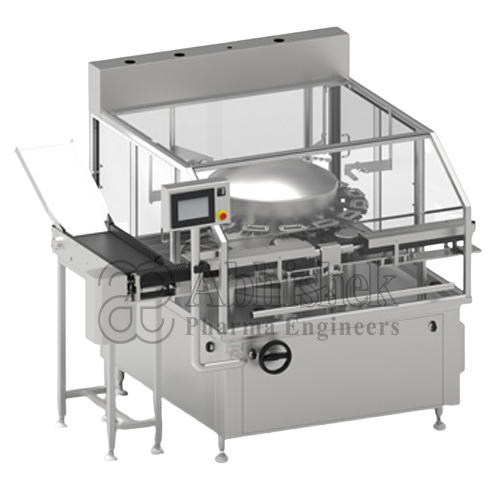
Advanced Vial Washing Machine Manufacturer
The integrity of any pharmaceutical injectable begins with absolute sterility. A Rotary Vial Washing Machine is a critical piece of automated industrial equipment designed to thoroughly clean and decontaminate glass or plastic vials before they are sterilized and filled. In the highly regulated pharmaceutical industry, removing particulate matter, dust, and microbial contaminants from vials is an uncompromising regulatory mandate to ensure patient safety.
As a leading Vial Washing Machine manufacturer, we understand that “cleaning” means more than just rinsing with water. During the manufacturing and shipping of empty glass vials, tiny glass splinters, cardboard fibers, or dust particles can settle inside. If these particles stay in the vial when the medicine is added, they could cause serious health risks. The washing machine’s job is to use high-pressure water and air to blast away every single microscopic piece of debris.
How the Vial Washing Machine Works
Our Vial Cleaning Equipment operates on a highly synchronized rotary or linear mechanism, ensuring each vial undergoes a rigorous, multi-stage cleaning cycle. The process is completely automated to eliminate human intervention and contamination risks:
- Infeed and Spacing: Empty vials are loaded onto a conveyor. The machine uses a “scroll” or a “star wheel” to separate them so they don’t bang into each other and break.
- Gripping and Inverting: A mechanical arm or gripper grabs the vial by its neck and flips it upside down. This is the most important position because it allows gravity to help the dirt and water fall out.
- Internal Washing: Thin needles rise up into the mouth of the upside-down vial. They spray high-pressure water (like a mini-power washer) to scrub the inner walls and the bottom of the glass.
- External Washing: While the inside is being scrubbed, nozzles located above and to the sides spray the outside of the vial to remove any surface dust or fingerprints.
- Air Blowing: After the water cycles, the machine blasts filtered, compressed air into the vial. This “air-knife” effect pushes out the remaining water droplets so the vial is dry and ready for the heat of the sterilization tunnel.
- Discharge: The grippers flip the vials back to an upright position and place them on a clean conveyor that leads to the next stage of production.
Technical Specifications Comparison
| Model | ARVW-120 | ARVW-240 | ARVW-300 |
| Output | Upto 7000 Vials/Hours | Upto 13000 Vials/Hours | Upto 17000 Vials/Hours |
| Suitable for | 1ml to 10ml | 1ml to 10ml | 1ml to 10ml |
| No. of Wash | Internal- 3 with Water & 3 with Air
External – 3 with Water & 1 with Air |
External- 3 with Water & 3 with Air
External – 3 with Water & 1 with Air |
External- 3 with Water & 3 with Air
External – 3 with Water & 1 with Air |
| Optional Accessories | IPC with 21 CFR Part 11 SCADA System
Exhaust System for WFI Station |
IPC with 21 CFR Part 11 SCADA System
Exhaust System for WFI Station |
IPC with 21 CFR Part 11 SCADA System
Exhaust System for WFI Station |
| Feature | All contact Parts SS316/316L (Mirror Finish) and Engineering Plastic
All Non- Contact Parts SS316/316L (Mat Finish) and Engineering Plastic All contact parts with the internal surface of Container and the wash media are made from AISI 316 Stainless Steel. Non-contact parts are made from engineering plastic and AISI SS 304. All finishes, welding joints are processed, treated & equipment selected in accordance with cGMP standards. Machine can use as a sole machine or inline. |
||
Model Selection Guide
Which machine is right for your facility? Consider these practical factors:
- Choose the ARAW-120 if: You have a smaller workspace or your daily target is focused on specialty drugs in smaller batches. It is the best choice for research labs or startup pharmaceutical companies in India.
- Choose the ARAW-300 if: You run multiple shifts and need to wash thousands of vials every hour to keep up with a high-speed filling line. This model is designed for “Clean Room” environments where the machine must run 24/7 with very little human interaction.
Common Applications
Our vial washing equipment is a staple in several high-standard industries:
- Human Injectables: For vaccines, insulin, and emergency hospital drugs.
- Sterile Filling Lines: Wherever a product must be 100% free of bacteria.
- Veterinary Medicine: Cleaning vials for animal health and livestock vaccines.
- Biotech Labs: Used for handling expensive biological liquids where zero contamination is allowed.
Quality, Hygiene, and Compliance of Vial Washing Machine
As a professional Vial Washing Machine manufacturer, we align every design with GMP (Good Manufacturing Practice). This means our machines have no “dead corners” where stagnant water could collect and grow bacteria. We use high-grade stainless steel that can withstand the heat and chemicals often used in pharmaceutical cleaning.
By removing all moisture and particles, our machines ensure that the vials are perfectly prepared for the sterilization tunnel. Our goal is to provide a consistent, repeatable process so that every vial leaving the machine is as clean as the one before it, protecting both the medicine and the patient who will eventually receive it.
FAQs for Rotary Vial Washing Machine
What is a Vial Washing Machine?
A Vial Washing Machine is a pharmaceutical machine used to clean glass vials internally and externally before filling. It removes dust, particles, and contaminants to maintain sterile production standards.
How does a Vial Washing Machine work?
The machine automatically feeds vials, holds them securely, inverts them, and performs multiple washing cycles using purified water, WFI water, and compressed air for complete cleaning.
Why is vial washing important in pharmaceutical manufacturing?
Vial washing is essential because injectable medicines require clean and sterile containers. Proper washing helps prevent contamination and supports product safety, quality, and regulatory compliance.
What vial sizes can be handled by the machine?
Most vial washing machines can handle standard vial sizes such as 2 ml to 100 ml depending on the model and change parts used.
What is the production capacity of a Vial Washing Machine?
Production capacity depends on the model. Many machines offer outputs from 60 vials per minute up to 240 vials per minute or more for high-speed production lines.
Is the machine built as per GMP standards?
Yes, quality vial washing machines are generally manufactured with SS 304 / SS 316L stainless steel parts and designed according to cGMP standards for hygienic pharmaceutical use.
Can the Vial Washing Machine be integrated with filling lines?
Yes, vial washing machines are commonly installed before sterilization tunnels and vial filling machines to create a complete automatic pharmaceutical production line.