

Giving Every Vial Its True Identity
Imagine a production line where thousands of tiny glass vials have just been filled with life-saving medicine. At this stage, they all look exactly the same—clear or amber glass with a silver cap. Without a label, a vaccine looks no different from a simple saline solution. This is where the Vial Sticker Labeling Machine steps in. It performs the vital task of wrapping a “birth certificate” around every vial, ensuring that doctors and nurses know exactly what is inside.
As a leading Vial Sticker Labeling Machine manufacturer, we believe that a label is more than just a piece of sticky paper. It is a promise of safety. A high-quality label must stay attached through freezing temperatures in a fridge and remain readable under bright hospital lights. If a label is crooked, wrinkled, or peeling off, it isn’t just an aesthetic problem; it’s a safety risk. Our machines are built to ensure that every sticker is placed with mathematical precision.
Choosing a trusted Vial Sticker Labeling Machine supplier in India means choosing a partner who understands the high stakes of pharmaceutical packaging. We design our machines to handle delicate glass with a soft touch while maintaining the speed needed for a busy factory. The result is a clean, professional-looking product that meets all international health standards and gives patients the confidence they need in their medicine.
The Labeling Process: How the Machine Thinks
If you were a new operator learning to run the machine, you would see that it “thinks” in a very logical, step-by-step way to avoid mistakes:
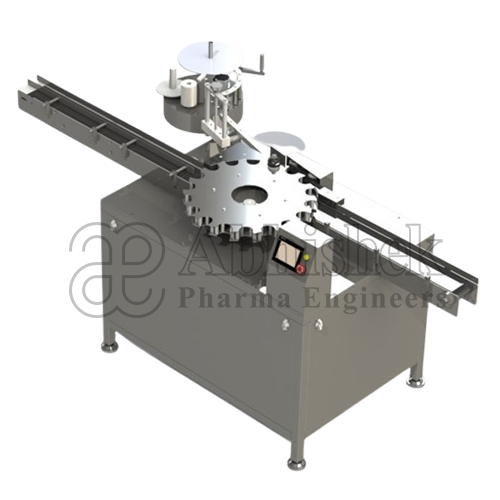
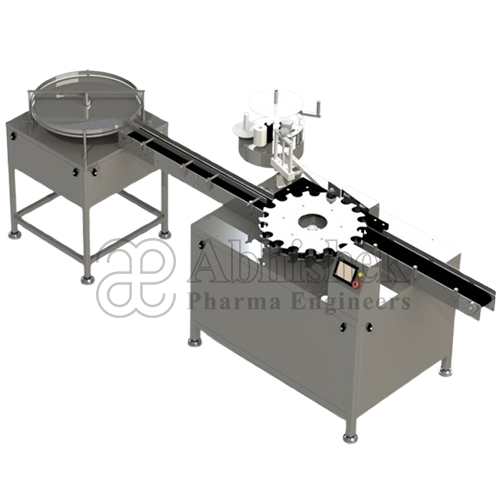
- Entry and Spacing: Vials arrive on a flat conveyor belt. A “scroll” or a “spacing wheel” creates a specific gap between each vial. This timing is crucial; if they are too close, the machine might miss a spot.
- Detection: A photo-electric sensor acts as the machine’s eye. It “sees” a vial pass by and tells the label dispenser exactly when to start moving.
- The Peel-Off: The label roll moves over a sharp “peeling plate.” As the backing paper makes a sharp turn, the stiff label stays straight, popping its sticky edge off the paper just as the vial arrives.
- Wrap-Around Application: The vial is moved into a “wrap-around” unit. Here, it is spun quickly against a soft rubber belt. This spinning motion pulls the label around the curved surface of the glass.
- Pressing and Smoothing: A secondary foam or rubber pad presses against the vial. This “massages” the label to squeeze out any tiny air bubbles and ensures the edges are stuck down tight.
- The Final Check: Some models include a rejection logic. If a sensor detects a vial without a label or a label that didn’t stick properly, a mechanical arm pushes that vial into a separate “rejection” bin so it never reaches the customer.
The Philosophy of Stable Design
Why do we build our machines the way we do? It comes down to three main goals:
- Vial Stability: Vials are light and can easily tip over. Our conveyors use side-guides and heavy-duty frames to prevent even the slightest wobble. A stable vial always gets a straight label.
- Alignment Logic: By controlling the rotation of the vial during the wrapping process, we ensure that the start and end of the label meet perfectly. This prevents “overlapping” or “spiraling.”
- Waste Reduction: Our machines are designed to stop instantly if they run out of labels or if a vial is missing. This prevents the machine from accidentally spitting out expensive labels onto the empty conveyor belt.
Technical Specifications of Vial Sticker Labeling Machine
| Parameter | AVSL-120 | AVSL-240 |
| Output Capacity | Steady (Up to 120/min) | High-Speed (Up to 240/min) |
| Application Logic | Wrap-around belt | Synchronized high-speed belt |
| Vial Sizes | 2ml to 100ml | 2ml to 30ml (Optimized for speed) |
| Label Flexibility | High (Paper & Film) | Very High (Transparent focus) |
| Accuracy Level | High Precision | Ultra-High Precision |
| Speed Control | Variable Frequency Drive | Full PLC / HMI Touchscreen |
| Detection Sensors | Infrared Gap Sensors | High-Frequency Fiber Optic |
| Rejection System | Optional Manual | Automatic Air-Blast / Pusher |
| Construction | Stainless Steel 304 | Stainless Steel 304 / 316 |
| Maintenance | Very Simple | Scheduled Technical Care |
| Scale | Small to Medium Pharma | Large Scale Global Supply |
Label Materials and Application Behavior
The Vial Sticker Labeling Machine is versatile enough to handle different types of stickers.
- Paper and Film: Most pharmaceutical labels are made of paper or a thin plastic film. Film is popular because it doesn’t tear or get soggy if the vial gets cold.
- Transparent Labels: For vials where you want to see the liquid inside, transparent labels are used. These require special “clear-on-clear” sensors to detect the gap between labels.
- Adhesive Logic: The machine’s pressing rollers ensure that the glue (adhesive) makes full contact with the glass. Since glass is non-porous, the pressure must be consistent to prevent “flagging,” which is when the label edges pop up after a few hours.
Quality Control and Compliance
To stay in line with GMP (Good Manufacturing Practice), we focus on three main quality points:
- Position Consistency: The label is always at the same height from the bottom of the vial.
- No Wrinkles: Our “Tension Control” system keeps the label roll tight so no air is trapped under the sticker.
- Smudge Prevention: If the machine includes a batch printer, we ensure the ink is dry before the vial enters the wrap-around station.
Line Integration and Workflow
As an experienced Vial Sticker Labeling Machine manufacturer, we ensure our equipment fits perfectly into your existing factory layout.
- Post-Sealing: The machine usually sits right after the Vial Cap Sealing Machine.
- Smooth Transfer: Vials move from the sealer to the labeler via a bridge conveyor to prevent any glass-on-glass crashing.
- Ready for Packing: Once labeled, the vials are ready for the final inspection and can be placed into cartons or boxes for shipping.
Maintenance and Changeover Simplicity
We know that “time is money” in a factory. That is why our machines are designed for fast changeovers.
- Cleaning: The flat surfaces and stainless steel body can be wiped down with alcohol in minutes.
- Roll Change: Changing a label roll takes less than five minutes. The “thread path” for the label roll is clearly marked on the machine.
- Vial Adjustments: To change from a 5ml vial to a 10ml vial, you only need to adjust a few hand-knobs to move the guide rails and the labeling head height. No special tools are required for basic adjustments.
FAQs for Vial Sticker Labeling Machine
What is a Vial Sticker Labeling Machine?
A Vial Sticker Labeling Machine is an automatic pharmaceutical packaging machine used to apply self-adhesive labels on glass or plastic vials accurately and efficiently. It helps display product details like batch number, expiry date, and dosage information.
How does a Vial Sticker Labeling Machine work?
The machine automatically feeds vials through a conveyor system, detects each vial with sensors, dispenses labels, and applies them precisely for wrinkle-free and accurate labeling.
Why is labeling important for vials?
Labeling is essential because it provides product identification, dosage instructions, batch traceability, expiry details, and regulatory compliance for pharmaceutical products.
What types of vials can be labeled by the machine?
Most vial sticker labeling machines are suitable for different sizes of glass and plastic vials used for injections, liquid medicines, powders, and laboratory products, depending on machine settings.
What is the production speed of a Vial Sticker Labeling Machine?
Production speed depends on the model. High-speed automatic labeling machines can label a large number of vials per minute, making them suitable for medium and large-scale pharmaceutical production.
Is the machine suitable for GMP pharmaceutical plants?
Yes, pharma-grade vial labeling machines are commonly manufactured with SS 304 stainless steel construction and hygienic design to support GMP requirements.
Can the machine be integrated with filling and sealing lines?
Yes, vial sticker labeling machines are commonly installed after filling, stoppering, and cap sealing machines as part of a complete automatic packaging line.