

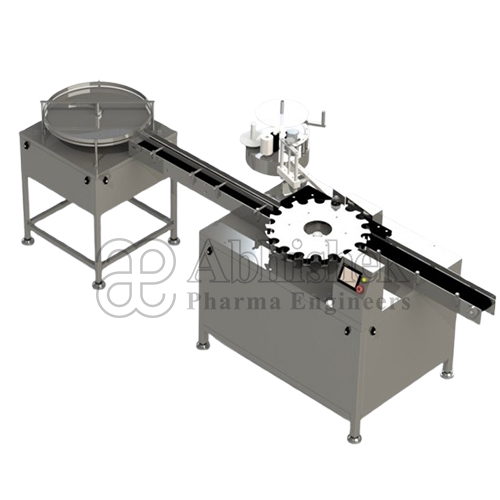
Abhishek Pharma is a bottle labeling machine manufacturer and supplier in Ahmedabad, Gujarat. Selecting the right machine depends on your bottle shape, label size, application position and required production output. These details help determine the suitable bottle-handling and label-application arrangement.
As a premier manufacturer based in Ahmedabad, Gujarat, we specialize in engineering cutting-edge packaging solutions. India is rapidly growing as a center for industrial machinery, and our locally manufactured Bottle Sticker Labeling Machine offers world-class precision, speed, and durability. Whether you require standard wrap-around labeling for round bottles or complex front-and-back applications, our equipment ensures every product leaving your facility looks flawless.
Finding a reliable Bottle Labeling Machine supplier in India is essential for any business that wants to reach a global standard. These machines are built to handle the high-speed environment of a modern factory while maintaining extreme accuracy. By automating the labeling step, companies can track their products more easily using batch numbers and expiry dates printed directly on the label. This ensures safety and helps the business comply with international trade and health laws.
How the Bottle Labeling Machine Works: Step-by-Step
If you were to stand next to a labeling line, you would see a very organized and logical flow of movement:
-
Product Infeed and Spacing : Bottles move down the line via a heavy-duty conveyor. An adjustable spacing wheel or scroll separator releases them one by one at calculated intervals to ensure perfect, unifom gaps before labeling.
-
Sensor Detection : As the bottle passes down the line, a high-accuracy photoelectric sensor detects its presence. It instantly sends a signal to the machine’s central PLC to trigger the label dispensing motor.
-
Application and Smoothing: The label makes contact with the bottle. A synchronized wrapping belt or pressing sponge smoothly rolls the label onto the container, ensuring strong adhesion without any wrinkles, creases, or air bubbles.
-
Quality Check and Discharge: The fully labeled bottles move down the outfeed conveyor, ready for final batch coding, shrink wrapping, and shipping.
- Label Pressing: A roller, belt or pressing pad firmly presses the label against the bottle. This removes air bubbles and helps the label stick evenly to the surface.
Why Choose Our Bottle Sticker Labeling Machine?
-
Practical Labeling Machine Expertise : Our understanding of bottle handling, label dispensing, sensor adjustment and conveyor synchronisation helps us develop machines for different packaging applications. The machine can be configured for round, flat, oval or rectangular bottles, depending on the selected model.
-
Accurate and Consistent Label Placement : The machine is designed to maintain label placement accuracy of approximately ±1 mm, subject to the bottle surface, label quality, product shape and operating conditions. Accurate positioning helps improve package appearance and reduce label wastage.
-
Bottle and Label Sample Evaluation: Bottle and label samples can be evaluated before finalising the machine design. This helps determine the suitable label dispensing system, guide arrangement, pressing mechanism and sensor position.
-
Reliable Sensor-Based Operation: Bottle and label sensors help control label dispensing at the correct position. Proper sensor selection and adjustment support consistent labeling while reducing missing, double or misplaced labels.
Types of Bottle Labeling Machine
Wrap Around Bottle Labeling Machine
This is the most common machine for round bottles.
- How it works: The bottle spins in place while a label is fed to it, wrapping the sticker entirely around the curve.
- Best for: Water bottles, syrup bottles, and jars.
Front & Back Labeling Machine
This machine is designed for flat or oval-shaped bottles.
- How it works: It has two label dispensers—one on each side—to apply two separate labels at the exact same time.
- Best for: Shampoos, lotions, and dishwashing liquids.
Top Labeling Machine
This machine applies labels to the flat surface of a cap or a lid.
- How it works: The labeling head is positioned directly above the conveyor belt and “tamps” or blows the label onto the top of the bottle.
- Best for: Jars of jam or medicine containers that need information on the lid.
Multi-Side Labeling Machine
This is a highly advanced machine for square or rectangular containers.
- How it works: It can apply labels to three or four sides of a square bottle in a single pass through the machine.
- Best for: Motor oils, chemical jugs, and high-end cosmetic boxes.
Technical Specifications of Bottle Labeling Machine
| Feature | Category |
| Bottle Shapes | Round, Flat, Oval, or Square |
| Label Size Range | Highly Flexible (Small to Large) |
| Label Roll Diameter | Standard Industrial Sizes |
| Speed Category | Medium to High-Speed Models |
| Material of Construction | Stainless Steel 304 or 316L |
| Automation Level | Fully Automatic / PLC Controlled |
| Power Usage | Standard Industrial Power |
| Maintenance Level | Low (Easy-clean design) |
Quality, Safety & Compliance
In a high-standard factory, a label must be more than just “on.” It must be perfect. Our machines follow GMP (Good Manufacturing Practice) standards. This means we focus on:
- Position Consistency: Ensuring every label is at the exact same height.
- Wrinkle Control: Using tension rollers to keep the label roll tight so no air is trapped.
- Readability: Ensuring the label is smooth so that scanners can easily read the barcodes and batch details.
Industry Applications of Bottle Sticker Labeling machine
- Pharmaceuticals: Labeling syrup bottles, tablet jars, and oral drops with clear batch and expiry data.
- Food & Beverage: Putting brand labels on water bottles, juices, and sauces.
- Cosmetics: Labeling shampoos, creams, and perfumes with high-quality, attractive stickers.
- Chemicals: Applying warning labels and instruction stickers to cleaning products and pesticides.
Integration with the Packaging Line
A Bottle Labeling Machine is usually the final step in a three-part team:
- Bottle Filling Machine: Fills the bottle.
- Bottle Capping Machine: Seals the bottle.
- Bottle Labeling Machine: Identifies the bottle.
By connecting these machines together, you create a fully automatic system that requires very little human help.
Maintenance and Ease of Operation
We design our machines to be user-friendly for operators:
- Roll Changeover: Changing a label roll takes less than five minutes. The path for the labels is clearly marked on the machine frame.
- Size Adjustment: To change from a big bottle to a small one, you simply turn a few hand-knobs to move the guide rails and the sensor height. No tools are needed for most changes.
- Cleaning: The stainless steel body can be wiped down with a damp cloth to remove any dust or leftover adhesive from the label rolls.
Bottle Labeling Machine Supplier in Gujarat for Packaging Lines
Abhishek Pharma is a bottle labeling machine manufacturer and supplier in Ahmedabad, Gujarat. The right labeling machine depends on bottle shape, label size, label position and required production speed. Matching these factors helps buyers choose a suitable configuration for their packaging line.
When choosing a bottle labeling machine supplier in Gujarat, check compatibility with your existing filling machine, capping machine and conveyor. Share your bottle and label samples to discuss application requirements and request a quotation. Confirm supported bottle formats, delivery terms and available installation, training and spare-parts support before ordering.
FAQs for Bottle Labeling Machine
What is a Bottle Labeling Machine?
A Bottle Labeling Machine is an automatic or semi-automatic packaging machine used to apply self-adhesive labels on bottles accurately and efficiently. It is widely used in pharmaceutical, food, beverage, cosmetic, and chemical industries.
How does a Bottle Labeling Machine work?
The machine moves bottles through a conveyor system, detects each bottle using sensors, dispenses labels, and applies them with precision. Some models also rotate bottles for wrap-around labeling and smooth label placement.
What types of bottles can be labeled with this machine?
Bottle labeling machines can handle round, flat, square, and oval bottles made of glass, plastic, or metal, depending on the machine model and setup.
Which industries use Bottle Labeling Machines?
These machines are commonly used in pharmaceutical, food & beverage, cosmetic, personal care, chemical, lubricant, and agrochemical industries where accurate product labeling is required.
What is the production capacity of a Bottle Labeling Machine?
Production speed depends on the machine model and bottle size. Many automatic machines are designed for medium to high-speed production lines with consistent labeling output.
Can the machine print batch number and expiry date?
Yes, many modern bottle labeling machines support online coding systems such as inkjet or thermal printers for printing batch numbers, manufacturing dates, and expiry dates during labeling.
Can the Bottle Labeling Machine be integrated with other machines?
Yes, bottle labeling machines are commonly connected after bottle filling and capping machines as part of a complete automatic packaging line.