

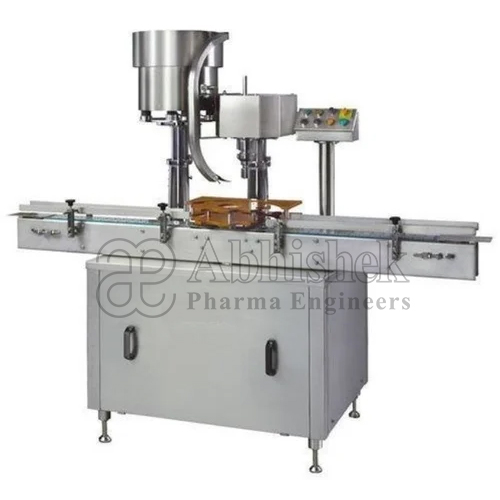
Abhishek Pharma is a bottle capping machine manufacturer and supplier in Ahmedabad, Gujarat. We review your bottle dimensions, cap design and production requirements to discuss a suitable capping configuration. A faulty seal can lead to oxidation, leakage, product contamination, or tampering, which can devastate a brand’s reputation.
Automated capping machines expertly apply, torque, and seal various closures—including plastic screw caps, metal lids, and aluminum roll-on pilfer-proof (ROPP) caps—onto bottles at high speeds.
For critical sectors like pharmaceuticals, food and beverage, cosmetics, and industrial chemicals, a hermetic seal is not just a requirement; it is a regulatory mandate. Based in the thriving industrial corridor of Ahmedabad, Gujarat, we are a leading manufacturer delivering world-class packaging solutions. By combining advanced Indian engineering with global compliance standards, we provide robust machinery that guarantees hygienic sealing, minimal product waste, and unmatched operational longevity.
Finding a reliable Bottle Capping Machine supplier in India is a key decision for any business. These machines provide a level of consistency that is impossible to achieve by hand. Whether you are dealing with a small plastic bottle or a large glass container, the machine treats every unit with the same discipline. This not only keeps the production line moving quickly but also builds trust with customers, who know that their product is fresh and has never been opened.
How Our Bottle Capping Machine Works
If you were a technician watching the machine, here is the logical flow of the capping process:
-
Cap Sorting and Feeding: Bulk caps are loaded into a vibratory bowl or an elevator-style cap sorter. The sorter aligns each cap in the correct orientation and feeds them down a precise delivery chute.
-
Bottle Synchronization: Filled bottles travel down a variable-speed conveyor. A star-wheel or timing-screw mechanism gently separates and aligns the bottles at exact intervals, ensuring they are perfectly positioned under the capping head.
-
Cap Placement and Pick-Up: As the synchronized bottle passes the chute, it smoothly strips a cap from the dispenser, or a mechanical arm precisely places the cap onto the bottle neck.
-
Precision Torque and Sealing: The capping head descends. For screw caps, a magnetic or servo-driven clutch applies exact rotational torque. For ROPP caps, threading rollers mold the aluminum shell directly onto the bottle’s glass or PET threads.
-
Quality Inspection and Discharge: The sealed bottle moves to the outfeed conveyor. The “No Bottle, No Cap” sensory system ensures that missing bottles do not trigger cap drops, preventing mechanical jams and reducing component wear.
Key Technical Design Features Bottle Capping Machine
-
Magnetic Clutch Torque Control: Overtightening can crack plastic caps or strip bottle threads, while undertightening causes leaks. Our capping heads utilize a magnetic hysteresis clutch, meaning once the exact preset torque is reached, the head smoothly slips. This guarantees uniform tightness across every single batch.
-
cGMP & FDA Compliant Construction: Designed specifically for sterile environments, the machine’s frame is clad in Stainless Steel 304, while all contact parts are crafted from surgical-grade SS 316. The smooth, crevice-free design allows for rapid washdowns and prevents bacterial buildup.
-
Tool-Less Changeovers: Production facilities often run multiple SKUs. Our machines feature calibrated hand-wheels and quick-release mechanisms, allowing operators to switch between different bottle heights, diameters, and cap sizes in under 15 minutes without specialized tools.
-
Intelligent PLC and HMI Integration: A centralized Programmable Logic Controller (PLC) continuously monitors machine health. Operators manage the system via an intuitive, full-color Human Machine Interface (HMI) touch screen, which displays real-time production metrics, batch counts, and diagnostic alarms.
-
Versatile Head Configurations: Available in single-head configurations for lower volume runs, up to multi-head rotary turrets (4, 6, 8, or 12 heads) for ultra-high-speed industrial production.
Types of Bottle Capping Machine
Screw Cap Capping Machine
This is the most common type. It uses rotating “chucks” or spinning rollers to twist plastic or metal caps onto threaded bottle necks.
- How it works: It uses a specific amount of turning force (torque) to ensure the cap is tight but not over-tightened.
- Best for: Water bottles, syrups, and cosmetic jars.
ROPP Capping Machine (Roll-on Pilfer-Proof)
ROPP machines are used for unthreaded aluminum caps.
- How it works: As the bottle moves under the head, special rollers “form” the threads of the cap by pressing the aluminum against the glass bottle’s neck.
- Best for: Glass bottles of medicine, olive oil, and spirits. It creates a “broken ring” seal that proves the bottle has never been opened.
Press-on / Snap-on Capping Machine
Instead of twisting, this machine uses vertical pressure.
- How it works: A pressing head or a heavy belt pushes the cap straight down until it “snaps” over a ridge on the bottle neck.
- Best for: Milk jugs, laundry detergent, and caps with “flip-top” lids.
Lug Cap Capping Machine
These are used for metal caps that only need a quarter-turn to seal.
- How it works: It applies a quick, firm twist to lock the “lugs” of the cap under the glass rim.
- Best for: Glass jars of pickles, jams, and sauces.
Technical Specifications of Bottle Capping Machine
| Feature | Category |
| Bottle Size Range | 30ml to 5 Liters (Adjustable) |
| Cap Compatibility | Plastic, Aluminum, Lug, or Snap-caps |
| Capping Method | Rotary or Linear |
| Speed Category | Low to High-Speed Models |
| Material of Construction | Stainless Steel 304 or 316L |
| Automation Level | Fully Automatic / PLC Control |
| Power Usage | Standard Industrial Grade |
| Maintenance Level | Low (Heavy-duty components) |
Quality, Safety & Compliance
In a professional packaging line, a “leaky bottle” is a failed product. Our machines follow GMP (Good Manufacturing Practice) to ensure that the capping environment is clean and safe. By providing a consistent seal every time, we help manufacturers prevent waste and ensure their products stay fresh throughout their entire shelf life.
Industry Applications
- Pharmaceuticals: Sealing syrups, oral liquids, and tablet containers.
- Food & Beverage: Bottled water, juices, and condiment jars.
- Cosmetics: Shampoos, lotions, and perfumes.
- Chemicals: Cleaning products, motor oils, and agro-chemicals.
Integration with the Packaging Line
A Bottle Capping Machine works best when it is part of a synchronized team:
- Bottle Filling Machine: Feeds the filled bottles directly into the capper.
- Bottle Labeling Machine: Takes the sealed bottles and applies the brand stickers.
- Inspection Systems: Often placed after the capper to check if a cap is missing or crooked.
Maintenance and Ease of Operation
We build our machines to be simple for operators.
- Daily Cleaning: The stainless steel body can be wiped down easily to remove any sticky residues.
- Cap Changeover: If you change your cap size, you can adjust the chute and the capping head in minutes using hand-knobs, meaning you don’t need a toolbox for every change.
- Routine Checks: Simple checks on the rubber rollers or the star wheel ensure the machine runs smoothly for many years.
Bottle Capping Machine Manufacturer and Supplier in Gujarat
Abhishek Pharma is a bottle capping machine manufacturer and supplier in Ahmedabad, Gujarat. Choosing the right machine starts with your bottle size, cap type and production needs. Share your bottle and cap samples, required output and existing packaging line details to discuss a suitable capping configuration.
For buyers looking for a bottle capping machine supplier in Gujarat, clear requirements help prepare a relevant quotation. Include your factory location, available floor space and any filling or labeling equipment that needs to connect with the capper. Confirm delivery arrangements, installation, operator training and spare-parts support when reviewing the proposal.
Contact Abhishek Pharma to discuss bottle and cap compatibility and request a quotation for your production requirements.
FAQs for Bottle Capping Machine
What is a Bottle Capping Machine?
A Bottle Capping Machine is a packaging machine used to tighten, seal, or cap bottles automatically or semi-automatically. It is widely used in pharmaceutical, food, beverage, cosmetic, and chemical industries to ensure secure bottle closure.
How does a Bottle Capping Machine work?
The machine moves bottles through a conveyor system, positions them under the capping head, feeds caps automatically, and tightens or crimps them with controlled torque for consistent sealing.
What types of caps can be handled by the machine?
Bottle capping machines can handle screw caps, ROPP caps, flip-top caps, lug caps, plastic caps, and metal caps depending on the machine model and tooling setup.
Which industries use Bottle Capping Machines?
These machines are commonly used in pharmaceutical, beverage, edible oil, cosmetic, chemical, agrochemical, and personal care industries where bottles need leak-proof sealing.
What is the production capacity of a Bottle Capping Machine?
Production speed depends on the model. Semi-automatic machines are suitable for small production, while automatic multi-head machines can cap a large number of bottles per minute for high-volume lines.
Is the machine made with stainless steel construction?
Yes, high-quality bottle capping machines are commonly manufactured using SS 304 or SS 316 stainless steel for durability, corrosion resistance, and hygienic production environments.
Can the Bottle Capping Machine be integrated with filling and labeling lines?
Yes, bottle capping machines are commonly installed after bottle filling machines and before labeling machines as part of a complete automatic packaging line.