

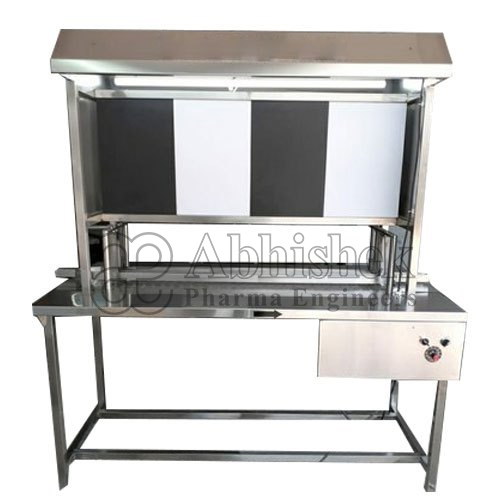
An Inspection Table is a specialized piece of equipment used to help workers look closely at medicine containers before they are packed into boxes. Think of it as a brightly lit stage where every bottle, vial, or ampoule gets its moment to be checked for perfection. In a factory that moves thousands of items an hour, it is easy for a small mistake to happen. This table slows things down just enough so that the human eye can catch what a fast-moving machine might miss.
As a leading Inspection Table manufacturer, we know that visual checking is the last line of defense in a medicine factory. When medicine is meant for an injection or a patient’s recovery, the container must be flawless. If there is a tiny crack in the glass, a piece of dust floating in the liquid, or a cap that isn’t sitting straight, the medicine is no longer safe. The inspection table provides the perfect environment—with the right light and movement—to find these hidden problems.
Finding a trusted Inspection Table supplier in India is vital for any company that follows strict safety rules. These tables are built to be part of an organized workflow, reducing the strain on workers while increasing the accuracy of the check. It isn’t just about a flat surface; it is about controlled movement and specialized lighting that makes defects “pop” out to the viewer, ensuring that quality is never sacrificed for speed.
How an Inspection Table Operates: Step-by-Step
The process is designed to be steady and logical so that nothing is overlooked:
- Product Entry: Bottles or vials move from the main production line onto the inspection surface, often via a conveyor belt.
- Controlled Movement: The table uses a motor to spin the products or move them in a line at a speed the operator can comfortably watch.
- Visual Check: As the products pass in front of a white or black background with bright lights, the operator looks for floating particles, cracks, or loose caps.
- Detection: If a “bad” unit is spotted, the operator can stop the table or simply reach out to grab the defective item.
- Separation: The rejected items are placed in a separate bin, while the perfect units continue their journey to the packing area.
Key Design and Construction Features
- Table Top Material: We use medical-grade Stainless Steel with a “mirror-finish” or a matte finish to prevent glare, making it easier for operators to see the product clearly.
- Rotation Control: The spinning speed is controlled by a digital knob. This allows the team to slow down for tricky products or speed up for simple checks.
- Lighting Arrangement: We use “cool-light” LED panels. These are positioned to prevent shadows and can be switched between white and black backgrounds to help see different types of particles.
- Ergonomic Design: The height of the table is adjustable so that operators can sit or stand comfortably, which prevents tiredness and keeps their eyes sharp.
- Stability: The machine is built with heavy-duty legs to ensure there is no vibration, as shaking makes it very hard to see small cracks in glass.
Types of Inspection Tables
Manual Inspection Table
This is a straight or square-edged table where containers move slowly across a flat surface.
- How it works: It uses a high-quality belt to slide products past one or two operators.
- Best for: Checking labels and cap alignment on larger bottles or boxes.
Rotary Inspection Table
This is a round, spinning disk that holds products around its edge.
- How it works: Vials or ampoules are fed onto the spinning plate. As the table turns, the containers spin in place, allowing the operator to see 360 degrees around the glass.
- Best for: High-speed checking of small glass vials and ampoules.
Conveyor-Integrated Inspection Table
This is a specialized section of the conveyor belt that features a glass or transparent floor with lights underneath.
- How it works: It allows operators to see the bottom of the container as well as the sides without having to pick it up.
- Best for: Large, continuous production lines where the product never stops moving.
General Technical Specifications
| Feature | Specification Category |
| Table Diameter/Length | Custom sizes (900mm to 1200mm standard) |
| Speed Control | Variable Frequency Drive (VFD) |
| Handling Capacity | Light to Medium loads |
| Material of Construction | Stainless Steel 304 or 316L |
| Automation Level | Semi-Automatic (Operator assisted) |
| Power Usage | Very Low (Energy-efficient) |
| Maintenance | Low (Minimal moving parts) |
Quality, Safety & Compliance
In a pharmaceutical environment, every machine must be easy to clean. Our inspection tables follow GMP (Good Manufacturing Practice). They have no sharp corners where dust can hide and are made of non-reactive steel. By supporting the operator with the best possible light and speed, these tables ensure that safety standards are always met and that no contaminated product leaves the facility.
Applications
Our inspection tables are used for:
- Ampoule Inspection: Checking for tiny glass shards or burnt tips.
- Vial Inspection: Looking for loose rubber stoppers or liquid clarity.
- Bottle Inspection: Ensuring labels are straight and fill levels are even.
- Syringes: Checking for air bubbles or needle defects.
Integration with the Packaging Line
An Inspection Table is the bridge between making the product and sending it to the customer. It connects with:
- Filling Machines: Receives the freshly filled containers.
- Capping & Sealing: Checks the work done by the capping heads.
- Labeling Machines: Ensures the identity of the bottle is correct.
- Packing Conveyors: Sends the “cleared” products to be boxed.
Maintenance and Ease of Operation
We design these tables to be simple and long-lasting:
- Daily Cleaning: The stainless steel surface can be wiped down with disinfectant in seconds.
- Lighting Checks: The LED panels are easy to reach and can be replaced without taking the whole machine apart.
- Speed Adjustment: The simple control panel allows any operator to find the right rhythm for their shift.