

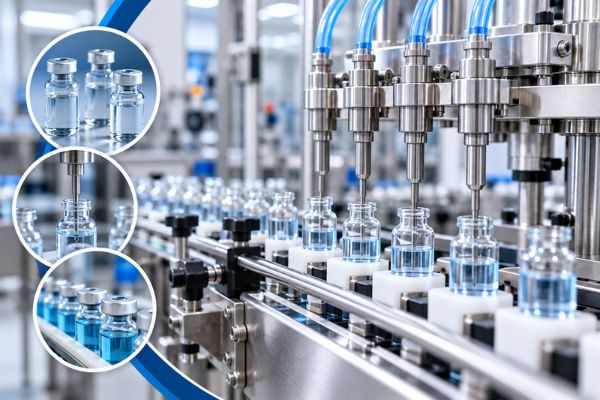
Where Does Product Loss Happen During Vial Filling
Product loss does not always appear as a visible spill. Liquid can remain in tubing, be consumed during setup or leave the line inside rejected vials. Choosing a Vial Liquid Filling Machine Manufacturer should include a discussion about where your product goes throughout the batch.
A fast machine may still deliver disappointing results if startup requires repeated adjustments or too much liquid remains after filling. For smaller batches, these losses can represent a larger share of the available product.
The useful buying question is therefore broader than production speed: how much of the prepared liquid becomes accepted filled vials? This guide explains how to evaluate that result without overlooking filling quality or process requirements.
Why Should Buyers Measure the Whole Batch
A machine demonstration often shows steady running after the settings have been adjusted. Daily production includes more stages.
Operators prepare the product path, prime the filling system, verify the first fills and manage interruptions. At batch completion, some liquid may remain in the supply vessel, pump or tubing.
Record these stages separately during a trial:
| Batch Stage | What to Measure |
|---|---|
| Setup and Priming | Liquid used before accepted filling begins |
| Normal Running | Accepted vials and fill variation |
| Stops and Restarts | Additional checks, rejects and adjustments |
| Batch Completion | Residual liquid in the product path |
| Inspection | Quantity rejected and reasons |
| Overall Result | Accepted output against starting quantity |
Use a consistent measurement method. Account separately for planned sampling and other authorised uses rather than treating every difference as machine waste.
How Can Small Overfills Increase Product Consumption
Repeated overfilling can consume a noticeable quantity across a batch.
For illustration, an unnecessary extra fill of 0.05 ml across 10,000 vials uses 500 ml of additional liquid. This is a calculation example, not a recommended tolerance or an expected machine result.
The approved fill target must account for the product and its requirements. Buyers should not reduce the target simply to improve yield.
Instead, assess whether the machine holds the approved target consistently. Ask for results across individual filling heads and throughout the trial.
An average can hide variation. Some vials may be above target while others are below it, even when the average looks acceptable.
What Product Details Affect Filling System Selection
The filling system must suit the formulation and operating conditions.
Viscosity, foaming behaviour, temperature and sensitivity to processing can influence how a liquid flows through the equipment. The required volume range also matters.
Give the manufacturer a clear product description, including:
- Target fill volumes and approved limits
- Viscosity under filling conditions
- Foaming or dripping behaviour
- Product compatibility requirements
- Expected batch sizes
- Cleaning and sterilisation needs
- Any restrictions on product handling
Different pump arrangements have different strengths and limitations. Avoid selecting a filling method from its name alone.
Where the actual product cannot be used during an initial demonstration, agree on a suitable substitute and document what that trial can establish.
Can a Shorter Product Path Reduce Residual Liquid
The product path includes the components carrying liquid between the supply vessel and filling nozzles.
Tubing length, internal diameter and component design affect how much liquid the path holds. A layout designed around the actual installation may help avoid unnecessary hold up.
Ask the manufacturer to explain the proposed arrangement and identify where residual liquid can remain.
Discuss drainability, disassembly and whether any recovery procedure is permitted within your process. Product remaining in the system should not automatically be returned to the batch.
Any recovery method needs an approved procedure that considers product quality, contamination risks and permitted holding conditions.
What Should You Check During Stops and Restarts
A filling machine should be evaluated during interruptions as well as continuous running.
After a stop, check the first filled vials for the agreed quality criteria. Depending on the product and system, dripping, bubbles or changes in filling behaviour may require attention.
Include planned stops in the acceptance trial. Record how operators restart, what checks are needed and how many vials are affected.
Also demonstrate missing vial detection where supplied. Confirm that the relevant nozzle does not dispense when a vial is absent.
Detection functions support process control, but they do not replace inspection or establish sterile performance.
How Do Cleaning and Changeovers Affect Batch Economics
A machine that fills quickly may still spend substantial time between batches.
Ask which product contact components need removal, how they are cleaned and which parts are replaced between products. Confirm access to pumps, nozzles and tubing connections.
Compare changeover time through to readiness for the next batch. Include assembly, checks and required documentation.
For sterile applications, suitable equipment is one part of a qualified production process. Stainless steel construction alone does not prove sterility or compliance.
Your production and quality teams should review the cleaning, sterilisation and environmental requirements alongside the machinery proposal.
What Evidence Should the Manufacturer Provide Before Purchase
Start with a written user requirement specification covering your product, vial formats, batch sizes and operating needs.
Agree on trial conditions and acceptance criteria before testing. Specify the fill measurement method, sampling plan, operating speed and stop conditions.
Request evidence that covers:
- Performance at the required fill volumes
- Results from each filling head
- Startup and restart behaviour
- Product remaining after batch completion
- Approved vial formats and change parts
- Utilities and installation requirements
- Documentation and training scope
For buyers in Ahmedabad, Gujarat and across India, clarify service arrangements and spare availability.
When discussing a machine with Abhishek Pharma, share representative vial samples and formulation characteristics. Request an application based proposal rather than choosing a model only by its advertised speed.
Conclusion
A suitable vial liquid filling machine should support consistent filling while making product losses visible and measurable. Evaluate startup, steady running, interruptions and batch completion as one connected process.
Before ordering, agree on fill criteria, product path design, trial conditions and documentation. These checks give your team a clearer basis for comparing equipment and planning production.
Frequently Asked Questions
Provide vial drawings, fill volumes, product characteristics, batch sizes and required output. Include cleaning, sterilisation, utilities and documentation requirements. State any limits on product handling so the proposed system can be assessed properly.
The suitable system depends on viscosity, volume, compatibility and processing sensitivity. Ask the manufacturer to compare suitable options against your formulation. A representative trial provides stronger evidence than a general claim about one pump type.
Agree on a measurement method and acceptance limits before the trial. Review individual vial results across every filling head and different batch stages. Confirm the volume, product conditions and operating speed used to support the accuracy claim.
A suitable configuration may help limit priming losses, rejects and residual liquid. Request a trial close to your normal batch size. Compare accepted output and remaining liquid rather than assuming a larger machine produces better recovery.
No. Sterile production also requires a suitable facility, controlled processes, qualified equipment and trained personnel. Confirm the machine’s role within your planned process with your quality team before finalising the purchase.
Integration may be possible after reviewing vial transfer, operating rates, conveyor arrangements and control interfaces. Share the existing line layout. Ask who is responsible for modifications and how the connected system will be tested.
Include the approved specification, supplied parts, acceptance tests, documentation and installation scope. Confirm training, warranty terms, delivery conditions and service support. Record any performance commitments with their test conditions and limitations.